Inside Tomorrowland: The Machine Behind the Magic
- Christopher
- 2 days ago
- 6 min read


One minute you're in the routine of everyday life. Next, you're standing in a field in rural Belgium, staring up at a stage the size of a small office block, surrounded by people from every continent on earth. At Tomorrowland, the transition from ordinary to extraordinary is engineered with extraordinary precision and that, depending on your perspective, is either its greatest achievement or its most revealing tension.
Inside Tomorrowland: The Machine Behind the Magic
Set in the small town of Boom, roughly 25 kilometres south of Antwerp, Tomorrowland has spent two decades constructing what its organisers call "the most magical place on earth" It's a claim that invites scepticism, and yet standing inside it, even the most cynical attendee tends to pause. Call it a festival, a brand, a spectacle, or a phenomenon Tomorrowland has been called all four. What it actually is depends largely on where you're standing.
From a Field in Boom to a Global Brand
Tomorrowland was first introduced to the world on August 14, 2005, when brothers Manu and Michiel Beers held the first edition through their company We Are One World.
That inaugural event was modest by almost any measure. Estimates suggest around 5,000 people attended, a far cry from the 400,000 across two weekends that the festival now accommodates annually. Electronic music was still finding its mainstream footing, and a boutique Belgian festival was not yet the cultural force it would become.
I
But the Beers brothers had a particular ambition right from the start. They weren't simply booking DJs and selling tickets. They were constructing a world, one with its own visual language, its own mythology, and an increasingly sophisticated sense of what a festival could look like when production values were treated as seriously as the music itself.
Growth came quickly. By the late 2000s, attendance was rapidly climbing into the tens of thousands. By the early 2010s, as EDM exploded across North America and electronic music began filling arenas globally, Tomorrowland had positioned itself as the flagship event of the genre's commercial ascent. In 2014, demand had grown so far beyond capacity that the festival expanded to two weekends for the first time, effectively doubling its footprint overnight and selling out both within minutes.
What followed was a period of aggressive brand expansion. Tomorrowland Brasil launched in 2015, though it folded after two editions. TomorrowWorld in Georgia, USA, ended more dramatically, but still the 2015 edition was beset by severe logistical failures, leaving thousands of international attendees stranded on-site without adequate transport. It was a rare and significant stumble for an organisation that had built its reputation on seamless execution, and a reminder that the Tomorrowland machine, however impressive, is not immune to the pressures of overextension.
The Belgian original, however, has remained remarkably consistent. Each year brings a new theme, a new stage design, a new chapter in an ongoing narrative that the festival takes seriously enough to invest millions in.
The 2023 theme, "Reflection," saw the mainstage transformed into an elaborate forest-meets-cosmos construction. In 2024, "LIFE" continued that tradition of theatrical ambition. Whether these themes add genuine meaning to the experience or serve primarily as marketing scaffolding is a debate that regular attendees have with themselves more often than Tomorrowland's promotional material would suggest.
The Soundtrack, and Who Gets to Make It Inside Tomorrowland: The Machine Behind the Magic
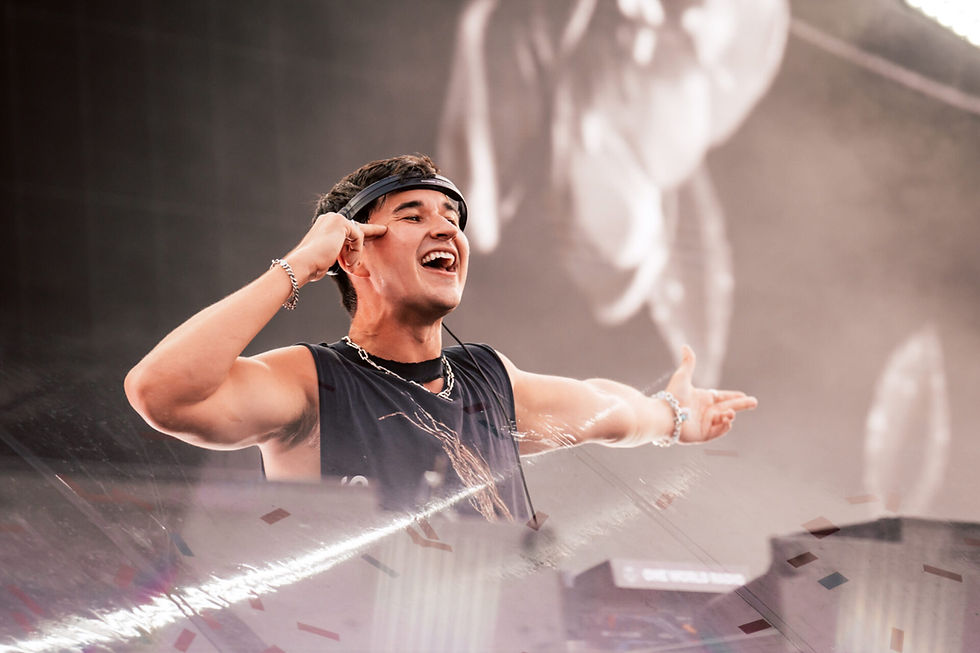
Each summer, Tomorrowland publishes a line-up that is, by design, a statement. Global superstar DJs like Martin Garrix, David Guetta, Tiësto, Hardwell and Armin van Buuren reliably anchor the mainstage, drawing the festival's largest crowds and guaranteeing the kind of international commercial appeal that keeps the crowds interested and livestream figures high.
Inside Tomorrowland: The Machine Behind the Magic
These are not, it should be noted, underground artists. They are among the most commercially successful performers in electronic music, and their presence at Tomorrowland's centrepiece stage reflects the festival's frank acknowledgment that its primary audience is not the techno purist or the warehouse regular. It is, broadly, the world people for whom Tomorrowland may represent their first or most significant encounter with electronic music culture, arriving from countries where the scene has no equivalent infrastructure.
Away from the mainstage, the festival's character shifts considerably. Deeper into the grounds, the CORE Stage sits within the treeline, marked by a towering sculpted face embedded in the forest.
The sets here run long deep house, techno, minimal and the atmosphere is genuinely different. Darker, more patient, the kind of crowd that has made a deliberate choice to be somewhere other than where the fireworks are.
The Atmosphere Stage, housed in a vast industrial-style tent, offers harder, driving techno with stripped-back production that feels almost confrontational after the mainstage excess.
These spaces represent Tomorrowland's ongoing negotiation with credibility, the implicit acknowledgment that electronic music's more serious practitioners and audiences exist, and deserve a place in the programme, even if they are not the primary commercial proposition.
Label-hosted stages add another layer. Anjunabeats, the trance and progressive label founded by Above & Beyond, brings a fiercely loyal global following that treats the stage less like a festival tent and more like a congregation.
Monstercat delivers high-energy bass music and melodic drum and bass to an audience that skews younger and increasingly international. These are communities operating within the Tomorrowland ecosystem distinct enough to feel genuine, visible enough to suggest the festival understands that genre loyalty runs deep.
The Flags, the Unity, and the Price of Entry
One of the most photographed images at Tomorrowland is the crowd itself specifically, the sea of national flags that rises above it. The festival leans heavily into the idea of itself as a gathering point for global electronic music culture, and the visual evidence supports it. In any given hour at the mainstage, you will hear conversations in Dutch, Portuguese, Brazilian Portuguese, French, English, Spanish, Hindi, and languages you cannot immediately place.
This internationalism is real and it is, in its own way, remarkable. Tomorrowland has built genuine global reach at a scale that few cultural events of any kind can claim. But the unity it celebrates exists within some significant constraints.
A weekend ticket to Tomorrowland, including accommodation in the festival's on-site DreamVille camping village, currently runs to several hundred euros before travel is factored in. Full packages, with upgraded accommodation, can exceed way into the thousands. The festival markets heavily to international visitors particularly from outside Europe for whom the total cost of attendance including flights can comfortably reach the equivalent of several months' average wages. Making the price tag of this event extremely high.
What It Actually Feels Like
The experience of being at Tomorrowland particularly for first-time attendees tends to produce a specific kind of disorientation that is difficult to manufacture and harder to dismiss.
Part of it is scale. The mainstage, in full operation on a Saturday night, generates a collective energy that is simply unlike most things available to the average person. The drop of a track at that volume, with that crowd, triggers a physical response that bypasses critical thinking almost entirely. You can be fully aware of the commercial machinery behind the moment and still find yourself undone by it.
The other part of it is detail. Tomorrowland's production design is obsessive in a way that rewards attention. The stages are not backdrops, they are full scale environments, built to be discovered. A walkway in a forest suddenly opens onto a hidden stage. A face carved into trees begins to feel, at 2am, like it might actually be watching you. These are not accidental effects.
Perhaps the most honest part is the simple fact of people. Tens of thousands of strangers gathered around a shared interest, in a field, for several days. The conditions for connection are constructed, but the connections themselves are not. Friendships formed at Tomorrowland tend to last. People return year after year, not entirely because of who is playing, but because of what the place has come to mean to them.
Still Leading, But by What Measure?
Nearly two decades on, Tomorrowland occupies a position in electronic music culture that no single competitor has yet managed to displace.
Ultra Music Festival in Miami and Creamfields in the UK both command serious followings. Glastonbury's electronic programming has grown significantly. ADE in Amsterdam has a strong claim on the industry end of the market. But none have replicated the particular combination of production ambition, global appeal and cultural weight that Tomorrowland has built around the world.
Whether that position reflects genuine musical leadership is a separate question. Tomorrowland has not historically been the place where new sounds emerge or where the genre's direction is set; work tends to happen in smaller rooms, in different cities, without the fireworks. What it has consistently done is take the sounds that have already proven themselves elsewhere and present them at the largest possible scale, with the most elaborate possible frame around them.
For many people, that is enough. For some, it is exactly what they want. And for a small but vocal contingent within electronic music culture, it represents everything that has gone wrong with a scene that once prized obscurity, access and rawness above all else.
Tomorrowland is unlikely to lose much sleep over that last group. But their existence and the conversation they represent is part of the story of what this festival is and has become. The world's biggest electronic music event is also, quietly, one of its most contested. That tension is not a flaw. It is, arguably, the most interesting thing about it.
Sony Expads AI Detection Research to Combat Copyright Risks in Music and Beyond