
Spotify Introduces “Verified by Spotify” Badge Amid Growing Concerns Around AI Music
- Christos

- May 7
- 4 min read
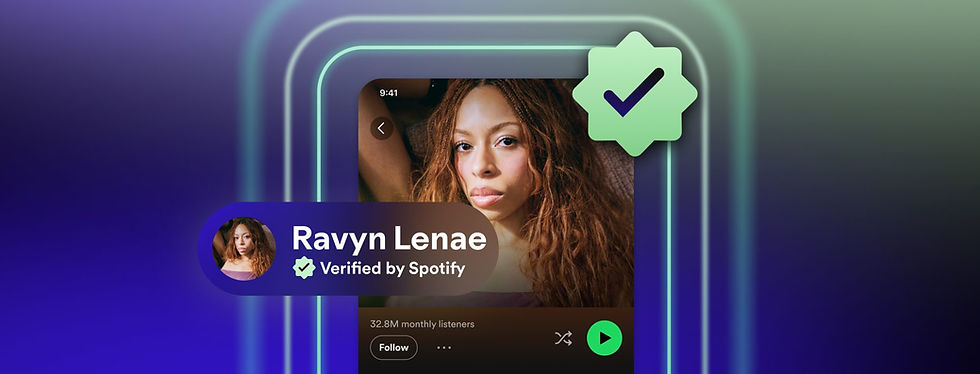
The streaming giant moves toward artist authentication as synthetic music floods digital platforms
Spotify is introducing a new layer of artist verification.
In a move that reflects growing industry concern around AI-generated music, fake artist profiles and synthetic uploads, the platform has officially announced the rollout of its new “Verified by Spotify” badge. The feature is designed to help listeners identify authentic artists while giving creators a clearer presence across the platform.
While verification systems are nothing new in digital culture, the timing of Spotify’s announcement is particularly significant. The streaming ecosystem is entering a new phase where questions around authenticity, ownership and identity are becoming increasingly difficult to ignore.
For electronic music especially, where anonymity, aliases and digital-first careers have long been part of the culture, the conversation feels especially relevant.
A response to the AI music surge
The launch comes amid a wider industry shift driven by the rapid rise of AI-generated music. Over the past year, streaming platforms have seen a sharp increase in synthetic tracks, cloned vocals and automatically generated artist profiles, many designed to imitate real musicians or exploit recommendation systems.
Spotify’s new badge appears to be part of a broader effort to create clearer distinctions between officially verified creators and the growing volume of artificial or misleading content circulating online.
According to Spotify, the verification system will provide listeners with greater confidence that the artist profile they are engaging with genuinely belongs to the creator behind the music. The company also positioned the feature as a way to strengthen trust between artists and audiences at a time when digital identity is becoming increasingly blurred.
Why Artist Verification Is Becoming Essential
The urgency behind Spotify’s new verification system becomes even clearer as AI-generated music begins moving beyond anonymous uploads and into mainstream streaming visibility. One of the most notable recent examples involved HAVEN., the British electronic duo behind I Run, a dance track that exploded across TikTok and climbed to No. 11 on Spotify’s U.S. chart before eventually being removed from major platforms.
The controversy centered around the song’s AI-assisted vocals, which listeners and rights holders claimed closely resembled the voice of Jorja Smith. Following growing scrutiny and copyright concerns, the track was reportedly taken down from TikTok and streaming services after being flagged under impersonation and rights policies. Although the duo later reworked the release with newly recorded vocals from singer Kaitlin Aragon, the situation highlighted how rapidly AI-assisted music can move from viral momentum to platform intervention.
Why this matters for electronic music
Electronic music has always existed close to technology. From drum machines and sampling to AI-assisted production tools, the genre has historically embraced innovation faster than most. But the current wave of AI-generated music introduces a different type of challenge.
In dance music culture, artist identity is often deeply connected to curation, exclusivity and sonic fingerprint. DJs build careers not only through releases, but through taste, selection and the emotional architecture of their sets. As AI tools become capable of generating increasingly convincing tracks within specific genres, the line between inspiration, imitation and replication becomes more complicated.
The rise of anonymous Spotify uploads and fake artist pages has also created frustration among producers who spend years building recognizable identities within niche scenes.
Verification systems may not fully solve that problem, but they represent a first attempt at creating clearer digital accountability.
More than just a blue checkmark
Spotify’s verification push is not simply about aesthetics or social status. It reflects a larger shift in how platforms are beginning to approach authenticity in the AI era.
For years, streaming focused primarily on scale and accessibility. Now the conversation is changing. Platforms are increasingly being forced to consider provenance, authorship and trust.
The introduction of “Verified by Spotify” suggests that digital identity may become a much more central part of music discovery moving forward. In practical terms, verified profiles could influence listener trust, playlist placement, algorithmic prioritization and long-term artist visibility.
As streaming ecosystems become more saturated, authenticity itself may become a competitive advantage.
Spotify Introduces “Verified by Spotify” Badge Amid Growing Concerns Around AI Music
The beginning of a wider industry transition Spotify Introduces “Verified by Spotify” Badge Amid Growing Concerns Around AI Music
Spotify’s announcement arrives during a period where the music industry is actively trying to define the boundaries of AI integration. Labels, platforms and artists are all navigating questions that still lack clear answers. What qualifies as original work? How should synthetic content be labeled? And how can platforms protect artists without slowing innovation?
These debates are likely only beginning.
What feels increasingly clear is that streaming platforms are moving toward a future where identity verification becomes as important as music distribution itself. The role of platforms may no longer be limited to hosting songs, but also validating the legitimacy of the creators behind them.
For listeners, the “Verified by Spotify” badge may seem like a small visual addition.
For the industry, it signals something much bigger.
Authenticity becomes the next battleground
As AI-generated music continues to evolve, the challenge facing streaming platforms is no longer just recommendation quality or catalog size. It is trust.
In a digital environment where music can now be generated, replicated and uploaded at massive scale, authenticity is becoming one of the most valuable currencies in the industry.
Spotify’s latest move suggests the platform understands that shift. The next phase of streaming may not simply be about discovering music faster.It may be about proving who actually made it.


