
Interview with Kevin Houben, Conductor of Symphony of Unity
- Rukh
- May 1
- 9 min read
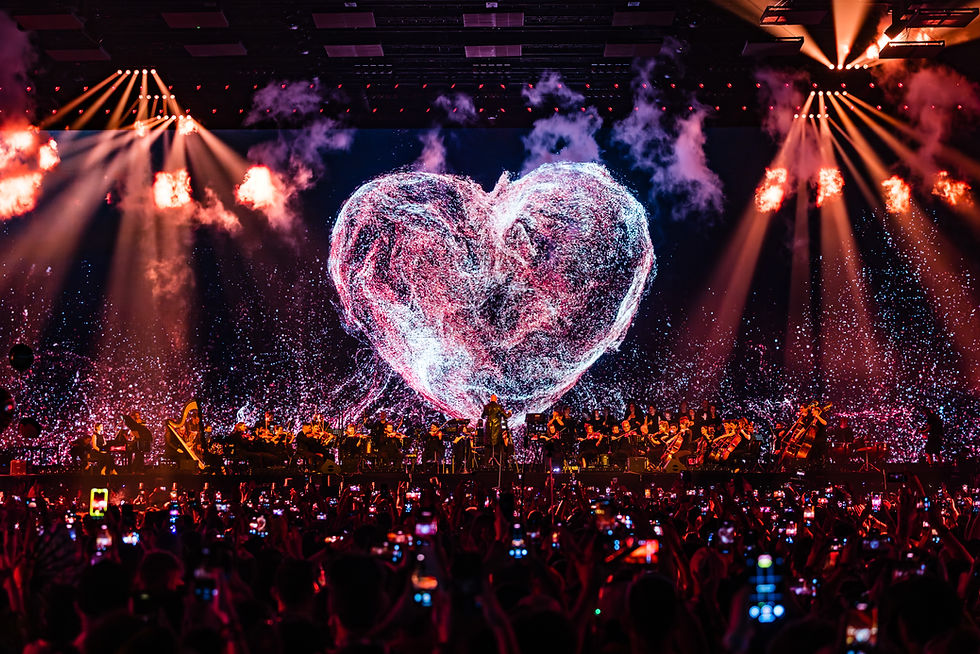
Created by the visionary minds behind Tomorrowland, Symphony of Unity first enchanted audiences in 2015 as part of the festival’s Secret Kingdom of Melodia theme. Since then, it has evolved into an internationally recognized concept, uniting people through the universal language of music.
With around 60 world-class musicians, the orchestra transforms iconic electronic tracks into sweeping, cinematic orchestral performances. By blending genres, Symphony of Unity bridges cultural and generational boundaries, resonating with both electronic music fans and lovers of classical compositions.
Following the release of the orchestra’s debut album Orchestral Selection I, we spoke to Symphony of Unity’s conductor, Kevin Houben, about how the project began, why now was the right time for the album’s release, and what we can expect in the future.
Hi Kevin, how are you doing today?
"I’m fine. I was working on another project this morning and I’m close to the deadline. After that, I’ll start with new music for Tomorrowland 2026."
How did Tomorrowland approach you for this project? What was the original brief when it all started?
"At that time, I was composing my First Symphony and in talks with the Belgian National Orchestra regarding a possible premiere, which put me on their radar. At the same time, they were looking for an orchestrator for their very first collaboration with Tomorrowland, and that’s how the orchestration assignment came my way.
Around the same period, Tomorrowland’s Creative Director, Christophe Van den Branden, was preparing a live orchestral performance with the Belgian National Orchestra. At Christophe Van den Branden’s request, Hans Zimmer composed a hymn for the festival, intended to be brought to life in a live orchestral performance.
That’s when I was approached to take over the orchestration of Zimmer’s score. That moment marked the beginning of my journey with Tomorrowland.
Coming from a purely classical background as a composer, conductor, and orchestrator, it felt like stepping into a completely different world."
It must have been a great new challenge to begin?
"Yeah, it was really different. At first, I didn’t really know what to expect; how it would sound, how the audience would react, or what our role as an orchestra would be within the festival.
But during the first rehearsal, I remember thinking: this might be the shortest rehearsal ever, because either the orchestrations wouldn’t work with the orchestra, or we have gold in our hands. And hopefully, it was the second.
The first performance exceeded all expectations. The energy from the audience and the orchestra was incredible. It felt like something truly unique was happening."
Symphony of Unity has become one of the most distinctive elements of Tomorrowland. Did you, or the orchestra, ever expect it to grow from a one-off concept into such a defining part of the festival?
"In the beginning that was never the intention, but after the really good response of the audience, things started to evolve quite naturally.
Later that same year, we performed live during the premiere of the Tomorrowland aftermovie, which happened very quickly after the summer shows.
Gradually, the team started thinking about the next steps. We began working on new arrangements and new music.
Christophe is always thinking ten years ahead of me. He’s a bit of a mystery in that sense, as he often sees things before they actually happen. Around 2019, he told me: "We should gradually expand Symphony of Unity, reach larger audiences, go into the studio to record an LP, and ultimately give it its own identity as an artist.”
The idea was no longer just to perform at festivals, but to build something that could travel the world.
At that time, I mainly thought it would just be exciting to return the following summer, to rearrange music and work again with my colleagues, Marcel Kaper and Hugo Tromp.
I didn’t yet share those long-term visionary ideas, but he turned out to be completely right. Today, we are essentially doing what he envisioned ten years ago, and that is quite exceptional.
That was back then his idea. For me, it was mainly about the enjoyment of coming back the following summer, orchestrating the music and working again with my colleagues. I wasn’t really thinking in those long-term, visionary terms. But he was totally right, so we are doing now what he was saying 10 years ago, and that is quite exceptional."
Symphony of Unity has been around since 2015. Why was now the right moment to release a debut album rather than keep it as a live-only experience?
"Because a lot of people reacted to the YouTube movies and started asking questions like, “Can we also listen to this on Spotify?” and whether there would be more music available, Christophe felt that it might be the right moment to start recording.
The reason it is happening in 2026 is because there is always a very intentional approach behind it. They try to find the right timing, to place things in the right context and give them the proper meaning. That is really part of the strength of the Tomorrowland approach, especially from Christophe, Michiel and their team. They have a very strong instinct for timing and feeling.
At the same time, the orchestra has also grown a lot. We now have our own website and Instagram, and there is a growing community following us. There are also several new shows coming up, including in Tenerife.
In summer, in July, we will perform in Belgium with five shows in total, four at the festival and the Love Tomorrow Summit in between. We also have a special show in Tenerife on the 12th of September, which is a new step for us. In addition, there are more connections with other festivals that are interested in hosting us. I cannot yet say where exactly we will be performing, but there will definitely be more concerts.
So it is becoming something quite special."
Symphony of Unity describes the album as adding a “cinematic layer” to iconic tracks. How does Symphony of Unity balance respecting the original with reinventing it?
"It is really important that the team preserves the intensity of the original music. What we do with Symphony of Unity is, in many cases, to extend the beginning by creating a longer introduction. Sometimes the rhythm is not immediately in its final form, or the musical lines are built up more gradually. We take more time before reaching the most recognizable part of the track, which is often the moment where people immediately react, especially during live performances, and go completely wild.
That is the approach the team takes when working on orchestrations and arrangements.
Another important element is the cinematic layer. Many people appreciate composers like Hans Zimmer and John Williams and the sound of large-scale film music. That is very beneficial for us, because it often includes rich string sections, brass, and horns that play counter-melodies above or below the main theme. At the same time, rhythmic elements and percussion can be used to strengthen the drive and energy, also within the strings themselves. This offers a wide range of possibilities.
In our case, we often take a more emotional approach when building up the tracks. Then, when we move into the drop, we naturally incorporate the electronic elements, with powerful and heavy beats.
In this way, we combine both worlds. The strings form the foundation of the layers, supported by percussion and brass, creating a full and unified sound."
Are there certain Tomorrowland anthems that feel almost made for orchestral reinterpretation?
"If you listen carefully to many EDM tracks nowadays, you will notice that strings are used very often. In tracks like Don’t You Worry Child, for example, the beginning is built mainly around strings, or more classical-inspired themes, similar to what Avicii also did.
We also make frequent use of the piano, and this is something that many EDM producers use as well. Because of that, there are strong musical connections with the original orchestral language of these tracks. I think this is a big part of why the combination works so well.
In many cases, these original tracks are not purely electronic. They already contain piano, strings, and even counter-melodies, very similar to classical writing, with layered structures that build on each other and strengthen the overall composition.
So in a way, that orchestral DNA is already present in the original material. What we do is simply reinforce that connection. We enhance the original songs with strings and make those elements even more prominent than in the original versions.
But it fits naturally, because even without our interpretation, there is already a strong element of classical orchestration within many EDM tracks."
Were there any tracks that didn’t translate well into orchestral form?
"No, even with some tracks that originally only consist of a few chords, you can do a lot through orchestration and sound design, by introducing the right melodic lines and working with the original vocals. That is also a very strong element.
The tracks we select are, of course, carefully chosen because we feel they are very suitable to work with.
So far, our team has had no difficulty in creating strong arrangements and orchestrations with the material we use.
At the same time, it is a large team that is constantly looking for new ideas and new music that could serve Symphony of Unity in the best possible way."
What’s the biggest technical challenge when translating electronic production into live orchestration?
"The first time I remember a track being played, everyone immediately recognised it and started jumping, shouting and screaming. At that moment, we actually had a small challenge: making sure the orchestra was loud enough to cut through the audience noise. That was something we had to deal with in the beginning.
We also initially thought it might be an issue to play very softly, especially with an audience of 8,000 to 20,000 people. But what we discovered is that there is a magical moment in the music when we play at a very soft level, and suddenly everyone becomes completely silent and really listens.
At first, we were a bit cautious about how soft we could go, but in reality it is not a problem at all. People really want to hear what we are doing, even when it is just a harp, a single piano, or a low bass line with double bass or cello.
So far, it has not been an issue at all."
Why do you think orchestral reinterpretations of EDM resonate so strongly with audiences right now?
"I think that, in some cases, the emotion and the build-up become even stronger than in the original versions. In my opinion, people are increasingly looking for simpler, more direct emotional experiences in life. Especially at festivals, there are many high-energy, fast-paced tracks playing wherever you go. In our show, we place the emotional aspect at the centre, and at times it almost becomes a moment of rest for the audience.
When people visit our performance, they sometimes experience a different pace. We also play softer passages, as I mentioned before, and not everything is fast or loud. In a way, it can feel almost like meditation, simply listening and feeling the music.
Even when it is not loud, you can see it in the musicians themselves, in their movements and expressions. When the camera zooms in on the brass players, for example, you see them breathing, and that feels very human. I think that resonates with people, and that is something many of us need in our lives. It is very important.
People connect not only with the music, but also with the musicians. Our visual team also plays a big role in this and does an exceptional job. The visuals are very beautiful and help create a moment where people can simply enjoy, feel calm, and connect with those around them.
We also see that many people become emotional during the performance. There are often people crying, so it really touches everyone in different ways."
Is Orchestral Selection I the start of a series? Can we expect more releases?
"If you look at the title, it is Orchestral Selection I, so one, two, three, four, and maybe more in the future. I cannot promise anything, but it is also our dream to continue and create more selections. I think that is part of the magic behind the title.
We also have upcoming shows, including Tomorrowland and Tenerife. There are many other exciting projects coming up, and I believe Symphony of Unity is really just at the beginning of its journey around the world."
Are there any artists or tracks that Symphony of Unity is dreaming of collaborating with or adapting next?
"Good question. I think one of the changes in the Symphony of Unity approach is that more DJs and artists are now making connections with Tomorrowland and reaching out about the Symphony. Some are suggesting new tracks, while others ask if the team could create reworks of their original music. So it is quite new that artists are actively engaging with us in that way.
As I mentioned before, the large team is continuously searching for new ideas and new musical approaches. They are also looking for new artists, as well as revisiting older iconic EDM tracks. There are many people involved in finding the right atmosphere, the right emotion, and the right repertoire.
A lot is still to come, and I am hopeful for many future collaborations."


